Last revised: February 2026
Altered Group Structure and Site Use in Bornean Bristlehead Following Playback Disturbance: Evidence from Long-Term Citizen Science Observations
Dixon Lau (Independent Citizen Scientist, Sarawak, Malaysian Borneo)
Date: 22 January 2026
Methods
Observations were conducted opportunistically between June 2023 and January 2026 within an approximately 3 km radius lowland peat swamp forest. Records consisted primarily of visual detections supported by photographic documentation during regular forest visits. Auditory detections without visual confirmation were not included in the formal record. Multiple sightings of the same individuals within short time periods, including within the same day, were treated as single records to avoid duplication. The observer is an independent citizen scientist without formal academic training in wildlife biology and did not use playback at any time.
Results
Between June 2023 and January 2026, a total of 52 visually confirmed records of Bornean Bristlehead were obtained at the study site. Records were distributed across most months during the study period, with higher detection frequencies observed between January and May 2025 (Fig. 1). Several months lacked records due to observer absence from the study region.
Prior to the disturbance event, Bristleheads were detected at relatively regular intervals, typically every 1–2 weeks, and most observations involved groups of three to six individuals. Occasional larger aggregations were recorded, whereas records of only two individuals were uncommon. Long-duration solitary individuals were not observed during this period; single birds were only briefly seen, usually accompanied by calls from nearby conspecifics.
Following the disturbance incident involving playback, which occurred approximately four months prior to the most recent observation, a sighting was recorded shortly thereafter, followed by a gap of nearly five weeks (18 September – 20 October 2025) without detections, despite almost daily site visits. Subsequent records resumed gradually, initially at longer intervals and later approaching pre-disturbance detection frequency. However, group size remained reduced, and no visual confirmation of more than two individuals was obtained during this period.
Occasional vocalisations were detected at distance following the disturbance, but group size could not be determined in the absence of visual confirmation and these records were therefore excluded from formal analyses. Observations at forest-edge locations also became less frequent compared with the baseline period.
During the most recent observation in January 2026, a single individual was recorded moving repeatedly within an area of approximately 600–800 m radius while vocalising persistently for more than one hour.
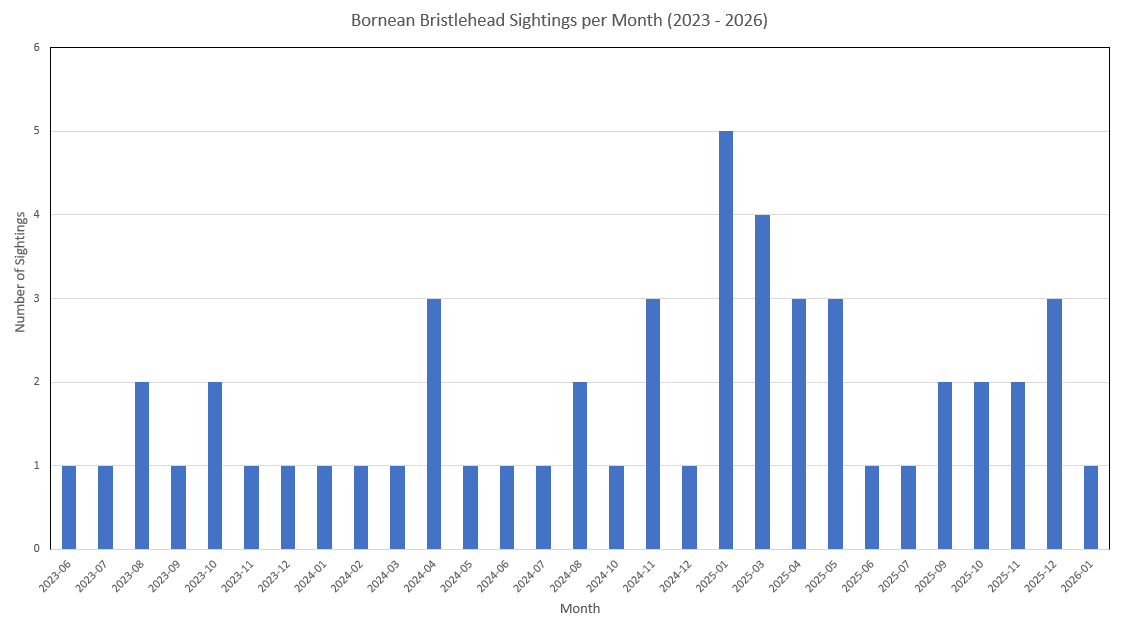
Figure 1. Monthly frequency of visually confirmed Bornean Bristlehead records from June 2023 to January 2026 at the study site. Months without records reflect periods of observer absence.
Discussion
The abrupt departure from a long-established detection pattern, combined with persistent reduction in group size and solitary vocal behaviour, suggests disruption of social cohesion rather than natural population fluctuation. Prolonged vocalisation by a lone individual may reflect attempts to maintain acoustic contact or to re-establish social cohesion, behaviours not recorded during the baseline period.
Given the species’ reliance on stable group structure, playback-related disturbance may have prolonged behavioural consequences. Although direct causation cannot be confirmed, the temporal association between playback exposure and subsequent changes in detection patterns supports the interpretation of disturbance-related effects.
The multi-year continuity of records suggests consistent site use by Bristleheads despite episodic disturbance, although changes in detection frequency and group size indicate potential short- to medium-term behavioural impacts. Multi-site or multi-observer studies would be valuable to assess whether similar patterns occur elsewhere and to further evaluate the long-term impacts of playback on this highly social species.
Conclusion
This case highlights the potential for playback to cause sustained changes in group structure and site use in Bornean Bristlehead and underscores the value of long-term citizen science observations in detecting behavioural impacts not evident from presence absence data alone.
About the Author
Dixon Lau is an independent citizen scientist based in Sarawak, Malaysian Borneo, with a strong interest in wildlife behaviour, documentation, and long-term field observations. Since 2020, he has recorded more than 56 visual observations of Bornean Bristlehead (Pityriasis gymnocephala) in Sarawak alone, across various habitats including mature secondary lowland forest, mangrove forest, and lowland peat swamp forest. In the study location, extensive observations were made possible by the species’ consistent presence and the site’s accessibility.
Since 2024, Dixon has adopted a more systematic and intensive approach to observation and documentation, with more frequent site visits and extended time spent in the field. As a result, his field experience and understanding of the species have deepened substantially. While not formally trained in academic wildlife research, he applies rigorous observation protocols, careful documentation, and consistent field monitoring to contribute valuable behavioural data and insights for conservation and public awareness.
Limitations and Disclaimer
The observations presented here were made opportunistically by an independent citizen scientist and do not constitute formal research or a controlled experimental study.
Detection frequency and group size may be influenced by environmental conditions, observer availability, seasonal variation, and natural movement patterns.
All observations were incidental, and no playback or manipulation was used by the observer.
Interpretations regarding potential behavioural impacts of playback by a certain party are descriptive and cannot be considered definitive evidence of causation.
While care has been taken to accurately document sightings and behaviours, limitations inherent to field observation, including observer bias and limited visibility, may affect data completeness.
These notes are intended to provide insight into Bornean Bristlehead behaviour and serve as a reference for future monitoring, but they should be interpreted with caution.
Citation
Lau, D. (2026). Altered Group Structure and Site Use in Bornean Bristlehead Following Playback Disturbance: Evidence from Long-Term Citizen Science Observations. Short Communication. Sarawak, Malaysia.
